
· Eric Koslow
A not-so-brief history of VStream
The history of VStream's original run. From its creation in May 2022 to its shutdown in April 2024
I originally started writing this as part of the Re:VStream article. But after a few hours of writing and recounting, I realized the history section was getting longer than everything else combined, and that people probably cared far more about what's to come than what happened in the past. Still, I enjoyed writing it, and I hope it's interesting to at least a few others out there.
Before VStream
VStream was started in May 2022 by me, Eric Koslow. But I had first come up with the idea about 18 months earlier. At the time I was the CTO and cofounder of a moderately successful startup, Lattice. I loved building Lattice, but the business changed dramatically during the pandemic. We, like many other businesses, had to become a WFH-only workplace. And as someone who gets so much energy from community and from seeing and interacting with people IRL, much of the joy of the job was suddenly gone. On top of that, we went from a company of 150 to ~500 during those first two years of the pandemic. I feel much more comfortable in small organizations than in larger ones (even organizations I started myself).
So the stage was set for me to look for other opportunities. One of the things I got into during the pandemic was VTubers. I still remember seeing my first Hololive clip, Miko trying to get directions to the Statue of Liberty from Coco, and thinking it was one of the funniest things I had ever watched. As someone who went to a specialized high school for studying Japan, and as a huge anime nerd, real-life anime streamers just made sense to me as a Japan thing. But then Hololive Myth debuted in September of 2020, and seeing creators like Gawr Gura get millions of subscribers in just a couple of months made me realize that maybe VTubing wasn't just a Japanese phenomenon. Maybe it had real international appeal and could even represent a new form of entertainment. At the same time, I noticed that the VTubers I watched were struggling on platforms like YouTube and Twitch. They were being harassed by adjacent communities that didn't understand them and unfairly punished by platforms that somehow assumed an anime avatar meant content just for kids. It felt like there might be a real opportunity to create something new and better.
Starting VStream
I created a transition plan to exit Lattice and started to envision what a better platform for VTubers (and creators in general) could be. I realized that the experience of creators and their fans was very disconnected. Streams would happen on YouTube or Twitch, VODs and music videos would be uploaded to YouTube, posting would happen on Twitter, offline chatting would happen on Discord, membership-only content would be hosted on Patreon, and merch would be sold via Shopify. All of these required separate accounts, and none of them talked to one another. For example, a creator could have far more followers on Twitter than they did on Twitch. Fans could earn a special badge on Twitch for being one of a channel's first subscribers, but they'd get nothing for being the first to buy something in a creator's latest merch drop. What if we created a more unified platform? Make it easier for creators to manage every aspect of their channel in one place, and let fans be rewarded and recognized for every way they improve the community, not just during the stream. That was, and is, the vision for VStream.
A little before I left my full-time position at Lattice, I incorporated VStream and raised a bit of money from friends, family, and friends' funds. When I announced my departure from Lattice to start this VStream thing, a few larger Silicon Valley investors I knew reached out asking if they could invest. They didn't understand this whole VTuber world I was interested in, but they had seen what I had done with Lattice and trusted me and my instincts. But I said no. I remembered just how much equity my cofounder and I had given up at Lattice in those early funding rounds, and thankfully I had made enough from my work at Lattice that I felt comfortable self-funding the first couple of stages and keeping more of the company for myself. This was something I would regret later on. See, it's much easier to sell the dream than it is to sell the numbers. Something I had forgotten from the early days of Lattice.
Debuts
I'm an engineer, so I was able to do the initial development work myself for about three months. But eventually it was time to hire some help, and that's when our first two engineers joined. In 2022, building an entire streaming service from scratch was a massive endeavor, and it was hard to even know where to start. So we chose not to start there at all. From the beginning, we expected it would be hard to convince people to move their streaming and communities to VStream. We were new, unproven, and a large part of the VTuber community is distrustful in general. So we agreed to start by creating value for the community first. Something unique to the VTuber community, compared with IRL streamers, is the concept of a debut. You work hard to either create or commission a model, you get a bunch of custom stream assets, maybe you've built a small community on Twitter, and then you make a big moment of your debut stream. And while debuts were happening what felt like every week or even every day, there was no central database of upcoming debuts. You could really only discover them if you happened to be on VTuber Twitter at the right time. We hired a design firm to help us out and set out to create a beautiful debut tool for VTubers. Our hope was that if we showed we truly wanted to support the community, it might engender enough goodwill that creators would trust us with more later.
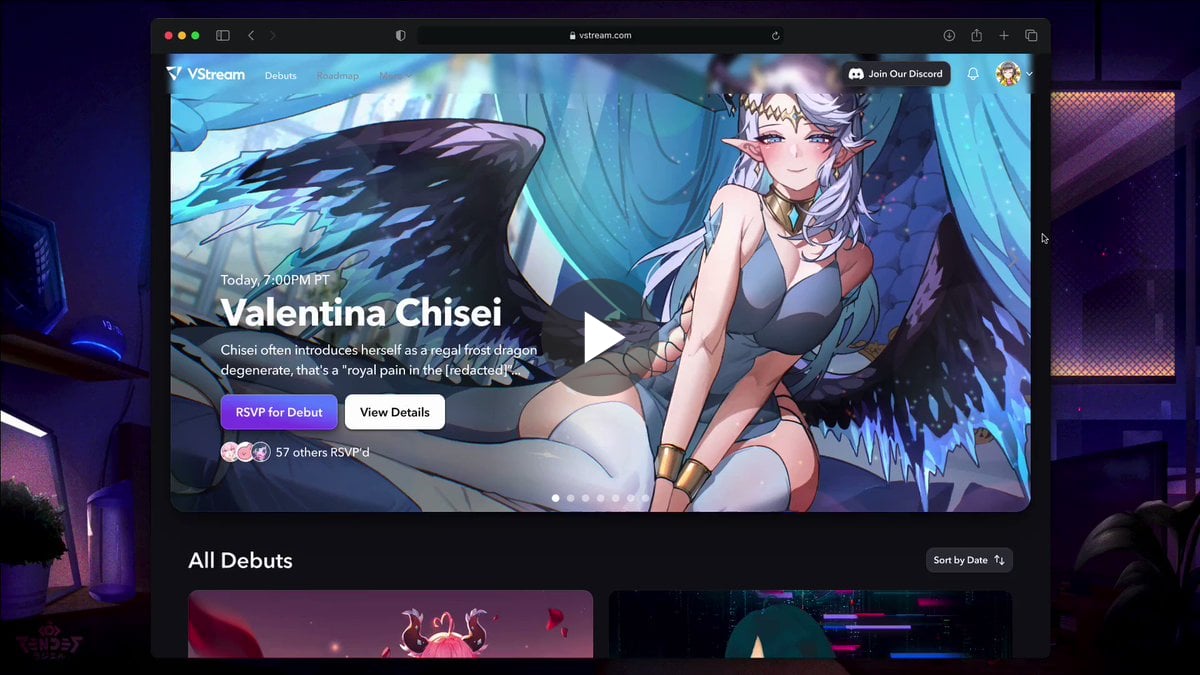
While I think the debut tool we created was beautiful and far better than anything else out there, it ended up being a big distraction and a waste of time. The product never resonated with the community, and it was barely used. But it did eat 2-3 months of our runway. From then on, we committed to focusing only on the core platform.
Waves
As the bare-bones streaming platform started to take shape, we needed to figure out how to generate interest and hype in VStream. We didn't want to spend all this effort only to have no one use it, like what happened with debuts. So we looked around to see what others in the space were doing. At that point VGen was also just getting started, and for their launch they were adding sellers onto the platform in groups every couple of weeks. We loved the idea and tried it ourselves with a VTuber "twist". We put out the call for VTubers who wanted to sign up for streaming on VStream.
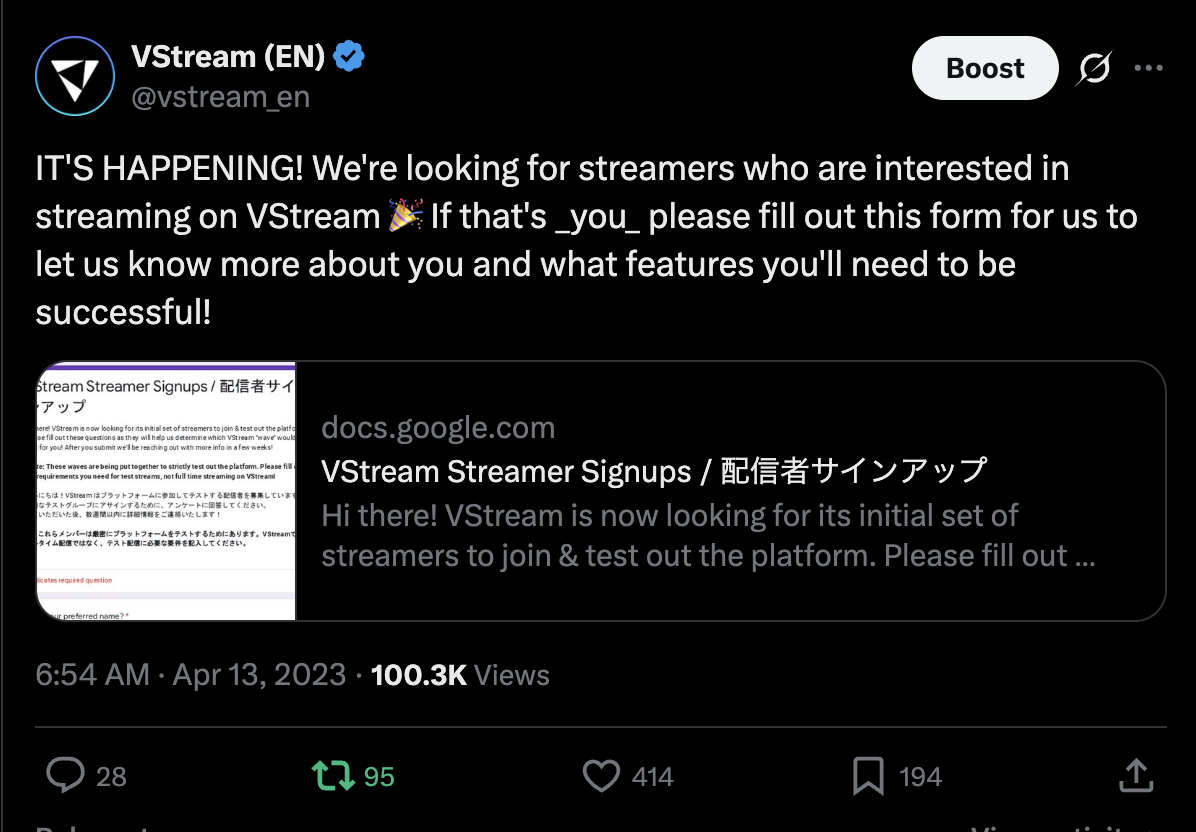
This brought in far more responses than we were expecting, which was exciting, but it also made it hard to choose who would be in which wave. We tried to have a good mix of different types of VTubers in each wave. Some folks already had plenty of followers, some were just getting started, some were American, others international, some had female models, others male models. We hoped that in every wave an audience member could find at least one streamer who appealed to them.
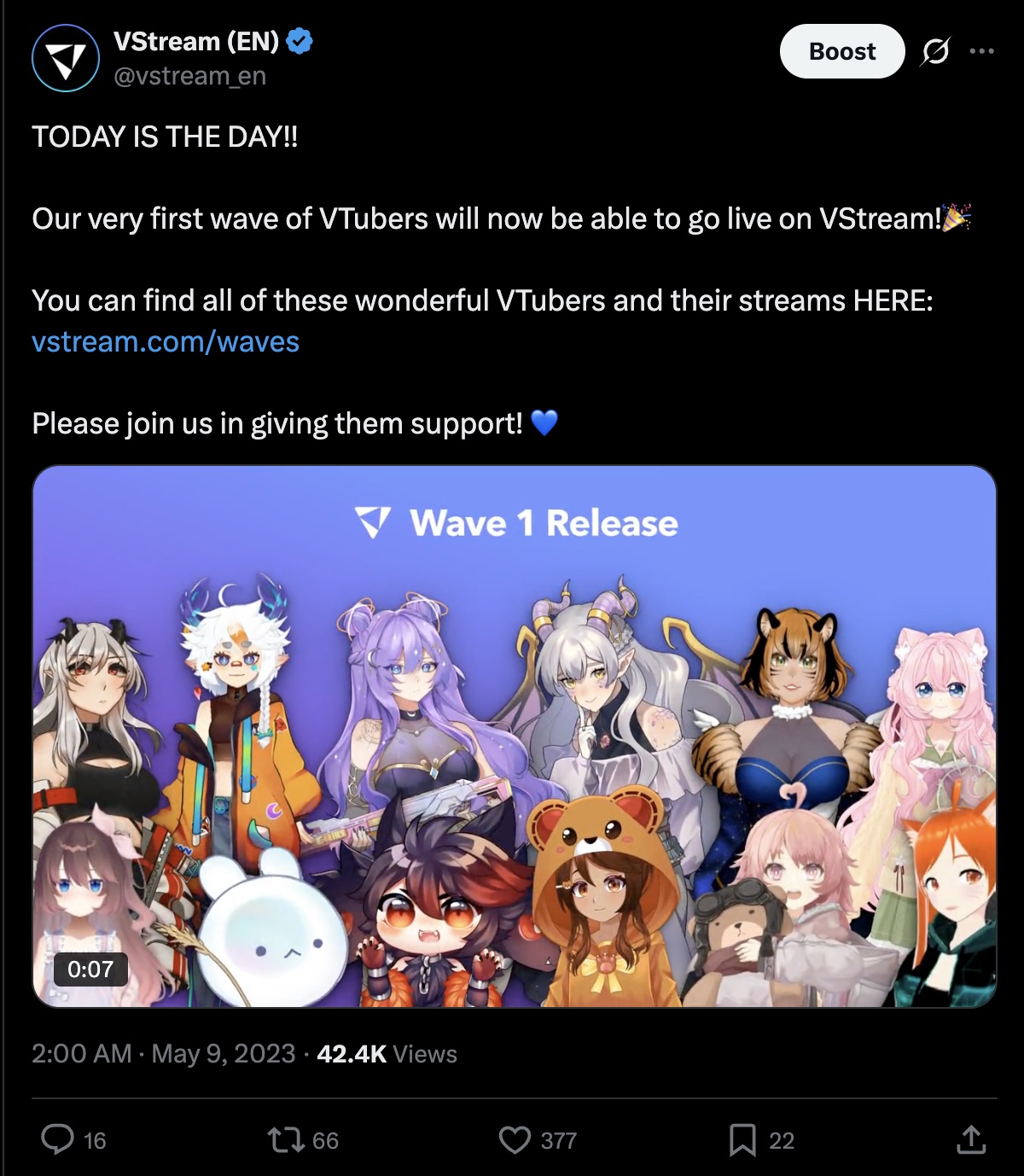
On May 9th, 2023, about a year after VStream was officially started, we had our first wave debut with 12 streamers. Two weeks after that, 27 more streamers started. Two weeks after that, another 18. And so on. We continued this for about four waves. The upside of our waves is that they created a marketable moment every two weeks for a few months. Not only would we make each one a big deal, but many of the wave members would also advertise their involvement. It also created FOMO in the community because it felt exclusive and special. The waves had their downsides too. First of all, they created plenty of confusion in the community about what exactly VStream was. Because debuts back then were often associated with agencies, some people thought VStream was a new talent agency and these VTubers were the people we now managed. Other VTubers who applied but were never accepted into one of the four waves never forgave us for it. And while we opened up the platform to anyone and everyone shortly after the waves finished, to this day I still hear from people who thought VStream was an invite-only streaming platform.
Struggling to grow
Once the waves and the invite system were over, VStream was open for anyone to stream on. This is where the cold-start problem truly reared its head. Every two-sided marketplace has to solve it: sellers cannot use a platform that has no buyers, and buyers cannot use a platform that has no sellers. This is true for all kinds of marketplaces. Dating marketplaces between men and women, ride-share marketplaces between drivers and riders, and marketplaces of attention like VStream between creators and viewers. While VTubers told us they liked what we were doing and what we had built, they didn't want to, or couldn't afford to, waste their time streaming on a platform that had no viewers. Viewers, on the other hand, would come to vstream.com and see a ghost town with very few interesting streams to watch, so they'd bounce as well.
We tried a bunch of different things to solve the cold-start problem. We tried partnering with (aka paying) established VTubers with larger audiences to spend a portion of their time streaming on VStream. That brought about 30% of their normal audience with them during those streams, but those viewers didn't stick around on the site after the streams were over. So we went back to that early vision for VStream. Maybe if we built out the integrated social side of VStream, people would have something to do between streams. Plus, by mid-2023 people were getting fed up with Twitter, and it seemed like there was a real chance they'd be open to trying something new. We put our time and attention into building that as our last big feature.
Getting desperate
Around September 2023, the writing was on the wall. We only had 6-9 months of runway left. My efforts to raise outside capital from investors were also failing. Those same investors who were willing to cut me a blank check 16 months prior were no longer so eager. Now that the site was launched, they wanted to see the growth numbers before they invested, and the growth numbers were not good. Or at least not good enough for a venture-backed business. I had also sunk over $2M of my personal money into VStream and couldn't justify putting even more in.
We needed a Hail Mary, and I thought I knew where to go for one. One of the other players in the space was the widely popular VTuber talent agency, VShojo. They too had raised venture capital (to the tune of close to $10M) and were located in the Bay Area. I had met the team a few times and had talked to their investors. I was aware they had two problems. The first was that when they raised all of that money, they promised their investors they would use it to build a tech platform that could reach venture scale. Instead, they had poured nearly all of the funding into the agency side of the business. Of their 30 or so employees, only three were working on their tech platform, and only one of those people was an engineer. The second problem was that they too were getting short on cash and having a hard time raising more.
I thought we could solve each other's problems pretty well. We had built a great tech platform that had the ability to scale, but due to our lack of popularity we were struggling to get past the cold-start problem. They had some of the biggest and most popular VTubers in the West with millions of fans, but they didn't have anything they had promised their investors, nor a culture of building products. While it wasn't what I had originally planned when I started VStream, I reached out to VShojo and offered to merge our businesses. It took some convincing and going back and forth, but on December 3rd, 2023, we signed a term sheet for the merger.
Ultimately this was a horrible decision, and one that many of my friends (and even my lawyers) tried to talk me out of. But unluckily for me, I had never been in a bad relationship before then, and I truly thought I could "fix them".
The VShojo mess
Even before the term sheet was signed, I could tell things were not going to be great. One of the reasons VShojo leadership was somewhat excited by the merger was the idea that I would be brought in to help them. While I had plenty of operating experience building and running a high-growth startup from my Lattice days, the VShojo leadership team had very little. And they had made a lot of mistakes because of that. When they gave me access to their books, I immediately saw a bunch of red flags. Not only were they spending far too much on things they shouldn't be (parties, T&E, marketing, etc.), they were mislabeling their costs to make the business look much better than it was. After I worked with their head of finance to fix it all, we found they had a negative gross margin, which is kinda unheard of. For them, that meant the contracts leadership had signed with their talents paid out more than they brought in, so every new talent contract made the losses grow faster. And this is before the salaries of VShojo staff, the marketing spend, the travel, and the parties were all tacked on. It became very clear where the $10M had gone.
Knowing all of that, I chose to move forward with the merger anyway. As I said, I was desperate to keep the VStream business alive, and this still seemed like our best chance to do that. I was given assurances that if we went through with the merger, they would clean up their act and get their spending in order. The term sheet also gave me explicit powers to make changes myself if required.
But while the term sheet was signed in early December, it took until early February for the merger to go through. This was mostly because while VShojo's CEO was on board with the merger, his cofounders weren't as hot on the idea. And one of those cofounders was put in charge of the legal process. Throughout December, that cofounder fought me and VStream's lawyers on what felt like every term in the contract. Which was maddening, because we both needed this deal to go through. We were each down to maybe 5-6 months of runway if we were lucky. The plan was that as soon as we merged, we would start fundraising in America and Japan as one entity. We thought investors would immediately see the "synergies" of the two businesses, and that we should raise a small bridge round to cover our short-term capital needs. Drawing out the legal process of the merger was dooming both of our businesses. At the end of the process the merged entity, VShokai Inc, was born. I had lost the assurances and legal powers that were in the signed term sheet (not cool or normal), so I had to pray VShojo would follow through with their end of the bargain.
Not following through with their end of the bargain
After the merger was done, we needed to do four things in rapid succession:
Announce to investors that the merger had gone through and raise money
Massively cut back on VShojo's spending so that the agency side of the business no longer looked like a money pit to investors
Explain the merger to the VShojo talents and get them on board with VStream
Tell the world about the merger and get people using VStream
Only 1.5 of those ever happened.
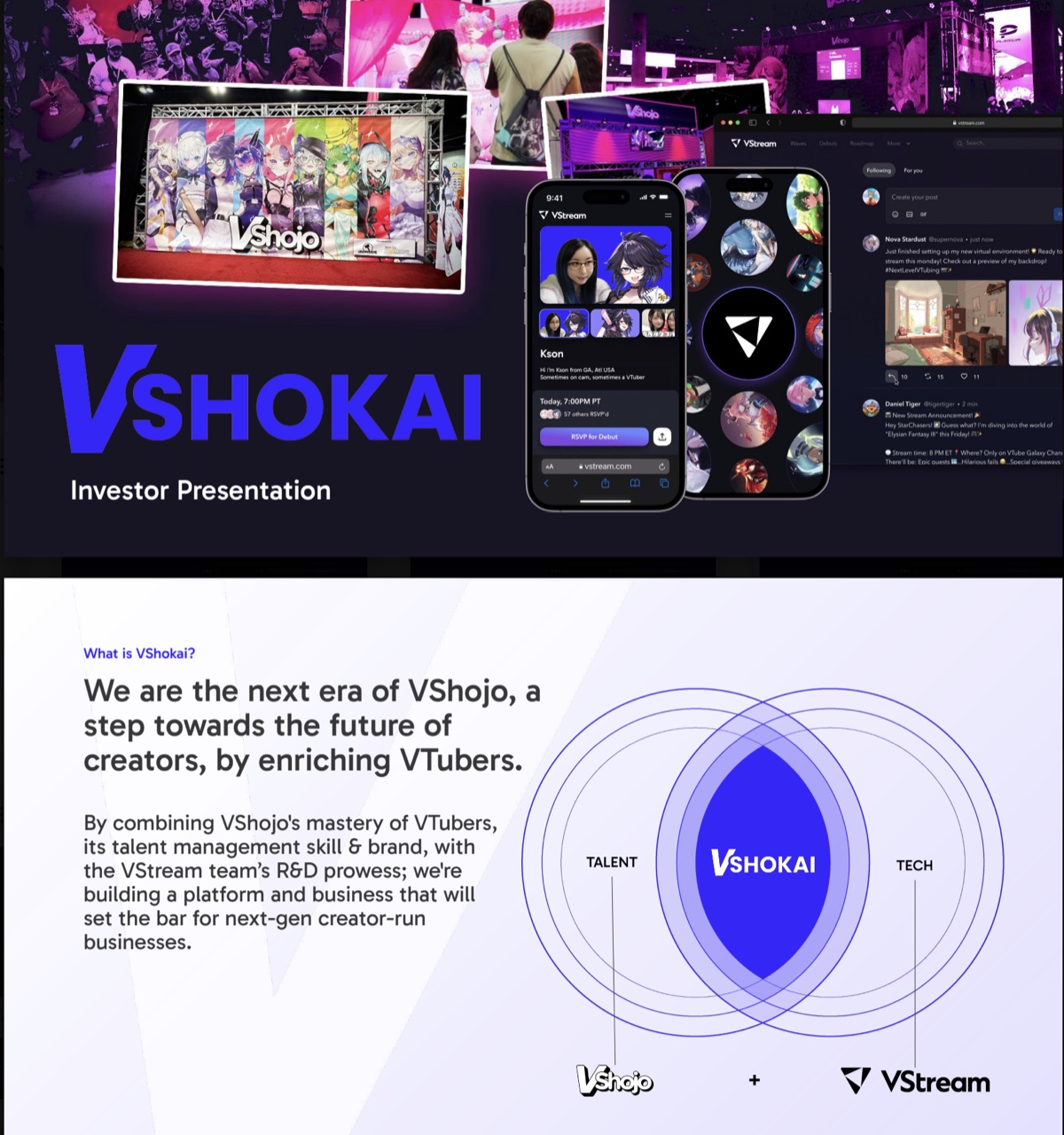
On the investor side, we quickly put together some pitch decks and started talking to investors in Japan and America. We had thought they would be excited about this new merged entity, but we were very wrong. When we talked to investors in Silicon Valley, the feedback was, "VStream seems interesting, but why did you all saddle yourselves with this talent agency thing that's burning $250k/month? We invest in tech, not talent agencies." And when we talked to investors in Japan, the feedback was, "We love VShojo and the cultural influence you all have, but why did you saddle yourselves with this unpopular VStream thing that isn't going anywhere and is burning $250k/month?" They didn't see or believe in the vision and told us to come back after we proved the combination was working. So the pressure was doubly on to get the talents on board and have them start to promote VStream (this would never happen).
Cutting costs wasn't progressing either. Because I now had to work through VShojo's leadership, I had no way to directly affect the business. And it was clear that leadership was more into the idea of cutting costs than actually doing it. Another lost cause.
Finally, on the talent side of things, it seemed that VShojo's leadership was less aligned with their talents than I was led to believe pre-merger. Instead of bringing the talents on board, leadership told me it would be better to leave them in the dark about what was going on. And the few who were told about it were skeptical of the idea of ever using VStream. But I was never given the chance to talk to the talents directly, so I don't really know what they were told about VStream or its relationship with VShojo.
Not having fun anymore
After struggling for two months to work with and through the VShojo leadership team, I was done. There was very little money around for either of us, and I realized I was no longer enjoying working on VStream now that VShojo's leadership was involved. Up until that point, I had the extreme fortune to have only worked with exceptionally talented coworkers. This was the first time I was dealing with real incompetence and not having the power to fire someone over it. I decided to call it for VStream. I made a deal with the VShojo leadership team that I would shut down the VStream side of the business. We would let go of all our staff and shut down the service. Shutting down VStream and giving VShojo the rest of the cash in the bank would give them a couple of extra months to hopefully figure something out. I would also trade all of my employee stock for the VStream intellectual property and give up my board seat. I didn't want anything more to do with the company.
And that was the sad end of VStream. VShojo went on to last much longer than the two months of runway I thought they had. When I would ask about it, I was told they had gotten a loan from a friend, that sales had picked up, and that they had cut costs. It was confusing, and just a tad frustrating, but in the end I didn't care anymore. As it happens, that wasn't where the money was coming from, but that's not my story to tell.
Reflections
I think I made many mistakes with VStream. I was a second-time founder, and I let that go to my head. I thought that just because I had started one moderately successful company, I could start another one in a completely different industry. I thought I could ignore conventional startup wisdom because I knew when it was okay to break the rules. The biggest mistakes I made were:
If the goal was to go down the billion-dollar-or-bust route, I needed to capitalize the business appropriately. Instead of being precious with equity, I should have raised as much money as possible as early as possible.
Instead of spending a ton of R&D dollars on technologies like our own transcoding servers, which would only help us when/if we got to scale, that same money should have been deployed on growth. Premature optimization is the root of all evil.
I needed to trust my gut when it said that someone wasn't going to be a good partner. It's just not worth it, and you can't change people.
But at the same time, I'm very proud of a lot of things as well. I think we created a great product. I think we cultivated an amazing community. I feel proud that VStream was an authentic reflection of myself and my values. And I'm very proud that I tried. VStream was an admittedly crazy thing to work on. It had very little chance of making it. But I wanted to give it my best anyway for the slim, slim shot it worked out. I don't regret starting VStream, but I do want to do it differently next time around.